Zirconia vs. PMMA: Which CAD/CAM Milling Material is Right for Your Dental Lab?

Zirconia vs. PMMA: Which CAD/CAM Milling Material is Right for Your Dental Lab?
Meisterstück Dental · Expert knowledge for dental laboratories
Choosing the right milling material is one of the key decisions in a modern dental laboratory. Zirconia and PMMA are the two most commonly used materials in CAD/CAM workflows – and they could not be more different. Knowing the difference saves material, time, and avoids expensive rework.
In this article, we explain which material is suitable for which purpose, which factors influence the choice, and how to make the right decision for your laboratory.
In brief:
Zirconia is for definitive, long-term stable restorations. PMMA is the material of choice for temporaries, splints, and cost-effective transitional solutions. Many laboratories work with both materials daily.
1. Basics: What are Zirconia and PMMA?
Zirconium oxide (ZrO₂) — the high-performance material
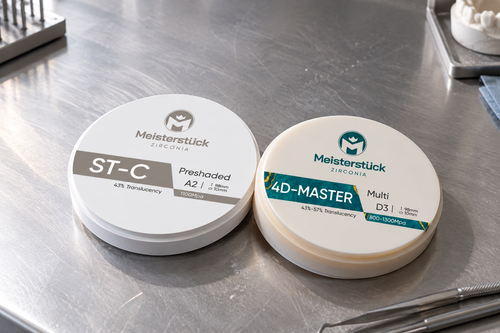
Zirconium oxide is a high-performance ceramic material with exceptional flexural strength and high biocompatibility. Modern multilayer zirconias combine mechanical strength with aesthetic properties — translucent variants are now also used in the anterior region.
Flexural strength: 800 – 1,400 MPa depending on variant (Standard, HT, Ultra-HT)
Processing: Dry milling in the pre-sintered state, followed by sintering at approx. 1,500 °C
Delivery form: Blocks (chairside systems like CEREC) and discs (open laboratory systems)
PMMA — the flexible all-rounder
PMMA is an acrylic-based plastic processed as a milling block or milling disc in the CAD/CAM workflow. It is significantly cheaper than zirconia, easy to mill, and offers broad indication flexibility.
Flexural strength: 80 – 130 MPa (depending on cross-linking and manufacturer)
Processing: Wet milling, no sintering process — ready for use immediately after milling
Delivery form: Monocolour blocks, multilayer discs, in VITA tooth shades (A1, A2, A3, B1 etc.)
2. Zirconia vs. PMMA at a glance
|
Property |
Zirconia (ZrO₂) |
PMMA |
|
Strength (MPa) |
800 – 1,400 |
80 – 130 |
|
Indication |
Definitive restorations |
Temporaries, splints, models |
|
Aesthetics |
High (multilayer available) |
Good (polishable, colourable) |
|
Cost/unit |
Higher |
60–80 % cheaper |
|
Milling type |
Dry |
Wet |
|
Sintering process |
Yes (~1,500 °C) |
No |
|
Biocompatibility |
Very high (ISO 13356) |
High |
|
Repair |
Conditionally possible |
Easy (repair resin) |
|
Wear time |
Permanent |
Weeks to max. 3 years |
|
System compatibility |
Open & closed |
Predominantly open |
3. Areas of Application: What Suits What?
When Zirconia is the Right Choice
Zirconium oxide is the material of choice for long-term stable, definitively supplied restorations:
– Crowns and bridges (monolithic or veneered)
– Implant-supported superstructures
– Veneers and inlays (with sufficiently translucent variant)
– Anterior restorations with high aesthetic requirements
– Abutments (with appropriate system)
Practical Tip:
For bridges up to 4–5 units, we recommend multilayer zirconia with at least 1,000 MPa. For monolithic anterior restorations, ultra-HT variants with 45–48% translucency are particularly suitable.
When PMMA is the Right Choice
PMMA always impresses when flexibility, speed, and cost-efficiency are required:
– Long-term temporaries (up to 3 years possible)
– Bite and bruxism splints
– Drilling templates for implant procedures
– Try-in restorations before definitive ceramic restoration
– Telescopic and primary crown frameworks made of plastic
– Orthodontic aids
Cost Comparison:
For the same milling effort, PMMA blanks are often 60–80% cheaper than comparable zirconia blanks. With a high volume of temporaries, this is a significant advantage for calculation.
4. System Compatibility: Open vs. Closed
Closed Systems (e.g., Dentsply Sirona CEREC / inLab)
These primarily use manufacturer-certified brand blocks – for zirconia (e.g., Cercon, CELTRA Zir) and PMMA (e.g., CEREC Tessera, Splint PMMA). Compatibility is explicitly approved by the manufacturer.
Open Systems (e.g., vhf, Amann Girrbach Ceramill, Roland DWX)
Open milling systems allow the use of a wide range of third-party suppliers. This opens up significant savings potential, especially for PMMA blanks. Laboratories can choose between premium brands and more affordable alternatives – depending on the indication and cost pressure.
Note for Buyers:
All materials in our shop are listed with system compatibility information. If you have any questions about suitability for your milling machine, please contact us personally at any time.
5. What to look for when buying
Quality Criteria for Zirconia
– Strength specification (MPa) and translucency grade suitable for the indication
– Adjust geometry to your milling machine (block size, blank dimension)
– Check CE certification and ISO 13356
– Order compatible coloring liquids
– Observe sintering times of the furnace – rapid sintering requires suitable materials
Quality Criteria for PMMA
– Prefer highly cross-linked varieties for long-term temporaries
– Choose MMA-free variants for patients with acrylate sensitivity
– Coordinate color selection for multilayer blanks before ordering
– Polishability: Relevance for splints and complete dentures
– Transparent variants for splints and aligners
6. Cost-effectiveness: Calculating Correctly
Many laboratories view material costs in isolation. In fact, material selection also influences milling time, tool wear, and rework effort:
|
Calculation Factor |
Zirconia |
PMMA |
|
Material Price/Unit |
Higher |
Significantly Cheaper |
|
Milling Time |
Longer (Dry) |
Shorter (Wet) |
|
Tool Wear |
Medium to High |
Low |
|
Rework effort |
Sintering, possibly painting |
Polishing |
|
Repair |
Complex |
Easily possible |
|
Billing potential |
High (GOZ) |
Lower (Provisional) |
For labs with a high volume of provisional restorations, PMMA is almost always the first choice economically. For labs with many all-ceramic single-tooth restorations, high-quality multilayer zirconia quickly pays off due to better billing positions.
7. Conclusion: No either-or
Zirconia and PMMA do not exclude each other — they complement each other. In a well-equipped dental laboratory, both materials are used daily: Zirconia for definitive, high-quality restorations; PMMA for fast, flexible, and cost-efficient solutions.
Anyone who consistently uses both materials according to indication and knows the system compatibility of their milling machine will work more efficiently, more cost-effectively, and with better quality.
Your next step:
At Meisterstück Dental, we carry zirconia blanks, PMMA milling discs, and the appropriate accessories — CE-certified, quickly delivered, with personal advice. Discover our CAD/CAM range at ms-dentaldepot.de.